SANOSTAT HELP CENTER
Frequently Asked Questions
Everything you need to know about SANOSTAT.
Explore answers to your questions about SANOSTAT.
Is SANOSTAT safe?
YES.
SANOSTAT only has 4 ingredients:
- 1.5% hydrogen peroxide
- 0.003% elemental silver
- 0.1% phosphoric acid – an inert, food-grade stabilizer
- Rest is purified water
No hidden ingredients. No scary chemicals.
TRULY SAFE. TRULY NON-TOXIC.
A version of this is sold by our Swiss office in sachets to armies so soldiers can disinfect their drinking water in remote places where potability is questionable. Safe enough for drinking water.
A version of this is also used by the biggest food companies in the world, in their production facilities, on critical food-contact surfaces without rinsing or neutralization. No need to rinse. No need to neutralize. Food-grade.
So, yes, SANOSTAT is safe.
Hydrogen peroxide? As in Agua Oxinada?
YES.
Hydrogen Peroxide.
Agua oxinada.
Water with an extra oxygen particle.
The same one used by our lolos and lolas since forever.
But make it highly stable.
Make it supercharged.
Call it Sanosil, which is a Swiss-made highly stable,
supercharged hydrogen peroxide.
The 3% Sanosil solution is SANOSTAT.
SANOSTAT is the 3% Sanosil solution. It’s just too long a name to remember,
so we came up with a different name for retail.
SANOSTAT / Sanosil S003 was created by a Swiss scientist in 1982 who found a way to use trace amounts of silver to make the hydrogen peroxide shelf stable for 3 years, and not to mention, incredibly effective. So effective, that it is certified as hospital-grade by no less than the German Society for Hygiene and Microbiology (DGHM). They’re the strictest, most important body in Europe for testing of high-grade disinfectants.
It’s safe, but does it kill the germs? I don’t want cutesy stuff. I want actual, reliable kill rate.
YES.
SANOSTAT kills germs. It is not some cute tea-tree-vinegar concoction.
SANOSTAT (under the name Sanosil S003) was tested and certified directly by the German Society for Hygiene and Microbiology (DGHM or VAH). Plainly, the DGHM is Europe’s most respected, most renowned scientific body specializing in hygiene and disinfection standards. All the important disinfectants are validated by them. All the important laboratories follow them. They have tested SANOSTAT directly and have certified that it provides hospital-grade disinfection with just a 15-minute wait time. Just 15 minutes, and it kills the worst hospital-germs.
So yes, despite appearances and all the safety claims, SANOSTAT truly kills the germs.
What is SANOSTAT? How is it related to Sanosil S003?
SANOSTAT is Sanosil S003 exactly.
It’s one and the same thing.
If you wanted to learn more about SANOSTAT,
you could just look up “SANOSIL S003”
and learn how it has been effectively used since 1982.
We are just calling it SANOSTAT
for the Philippine retail market.
Our marketing experts suggested it’s easier to ask
“Na Sanostat mo na ba yan?”
than
“Na Sanosil-es-zero-zero-three mo na ba yan
Safe and Effective? Both? Together? That’s unheard of.
YES. EXACTLY.
That was our exact same predicament back in 2009 when the hospitals were all still using aldehydes.
They could not believe that this watery thing could kill germs.
So, the hospitals did their tests,
and verified firsthand that we could and as effectively as the aldehydes did, but without the toxicity (aldehydes are now
banned in Europe and categorized as a probable carcinogen in the USA.).
As the Philippine hospitals began to learn, there was no more tough choice to be made:
Option 1: kill all the germs, but get cancer eventually (ie. aldehydes)
Option 2: Safe, but can’t kill all the germs, especially not the resistant germs
that are most dangerous to people (i.e. QUATS, chlorine, alcohol, etc.)
Enter Philippine Pharmaceutical giant UNILAB*.
We pitched the same to them, and they also would not believe it.
So they asked the experts at the Research Institute for Tropical Medicine (RITM)
and in all their other partner hospitals to verify our claims.
Shortly after, they became our first and biggest distributor since 2009.
And we became their first non-pharma, non-cosmetic product ever.
They brought us to all the hospitals all over the Philippines
SANOSTAT is a next-generation disinfectant.
There is no trade off here between safety and efficacy. SANOSTAT is both truly safe and truly effective.
What does the 99.99% germ reduction claim mean?
SANOSTAT has been validated by formidable European laboratories, such as the DGHM, to effectively show at least a 4-log reduction under defined test conditions.
A 4-log reduction = 99.99% reduction

As in the case of SANOSTAT, it achieves this kill rate instantly with some germs, for others about 5 to 15 minutes, and for some within 30 minutes. This depends on a combination of factors like the kind of germ, how much of that germ is present, how dirty the space is with organics and debris, and the kind of surface, among others.
So as a rule of thumb, just allow the treated surface to airdry for thirty minutes (no need to keep reapplying, just apply once and allow to air dry).
Can I spray SANOSTAT on a really dirty surface?
Cleaning is different from disinfecting.
Cleaning is to physically remove visible debris using soap and water.
Disinfecting is to kill the remaining, non-visible debris left behind after cleaning, i.e., germs.
Think of it this way: if you sneezed onto your hands and a lot of mucus now covered them,
would it be enough to just rub on some disinfectant? No, the mucus would still be there.
You must wash your hands first with soap and water to remove that mucus, otherwise the disinfectant you applied would not be as effective as it could be.
How well you pre-clean, determines how well it is disinfected after.
This is the ideal. As much as possible, this should be done to maximize the disinfectant effect.
But sometimes, when that extra cleaning process is not possible, use this to remove the debris until none is left.
If you wanted to show off how good SANOSTAT is, what would you say it kills?
It’s never good to show off. But since you asked…
Please search “BIOFILM.”
Then check if if your favorite brand kills biofilm.
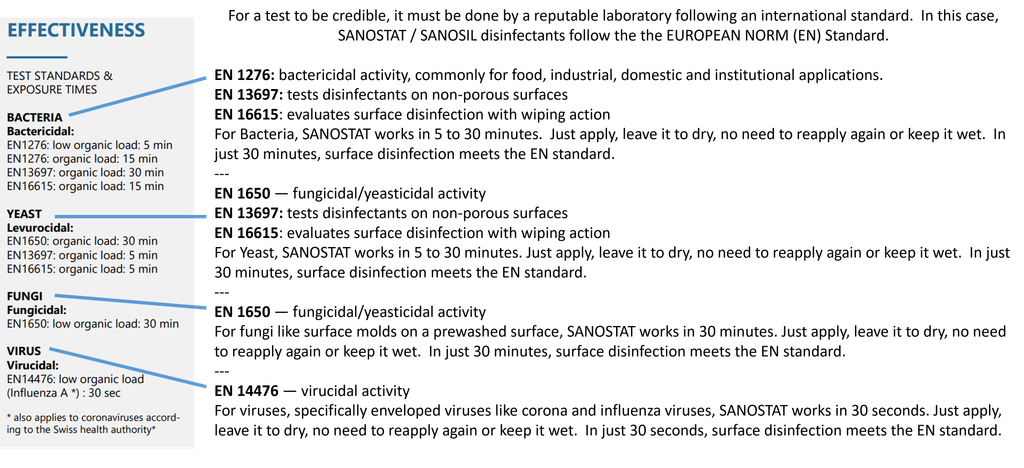
Can you explain the effectiveness chart?
Why haven’t I heard of SANOSTAT before?
The Swiss creator and manufacturer of SANOSTAT is a privately-held, family-owned company.
They have only ever sold to other businesses since 1982, never retail.
(By other businesses, we mean the biggest cooling tower facility in the whole Europe,
Swiss dairy giants, the Swiss government, etc.)
In the Philippines, SANOSTAT / SANOSIL variants have been used
in both the production areas of large-scale food manufacturers,
and the operating rooms of the most trusted hospitals since 2009.
We have clients that have been using us daily for 17 years now.
Turns out, those doctors and nurses and engineers and food techs
also want to use it at home, not just in their workplaces. Or so they have been telling us.
So, we decided to take the leap and start selling to households.
SANOSTAT is the first attempt to bring Sanosil to the retail market anywhere in the world.
Pa-uso talaga ang Pinoy, Go Philippines!
Silver? Isn’t that a heavy metal?
Silver has long been used in food and in medicine: silver coins in water vats to keep water potable during the galleon eras; silver amalgam or pastes applied to teeth to control decay; silver-lined catheters or silver-based burn-ointments to control infection.
Safety is in the details:
- Silver is a metal and silver is heavy, but it’s not that kind of heavy metal with health and dietary warnings like lead, mercury, cadmium, arsenic, chromium, nickel, copper and selenium. The difference? Silver is relatively non-bioaccumulative, or does not easily build up in the human body like those other metals. Ingested silver is easily eliminated by the body.
- The kind of silver also matters. SANOSTAT uses the safest kind, elemental silver, the same silver used for jewelry. Compared to silver nitrates and silver salts, elemental silver is less soluble, less available, less reactive, less hazardous. Incidentally, it is also the hardest form of silver to compound, and SANOSTAT is the only product worldwide that uses elemental silver in its disinfectant formulation.
- Dosage also matters. SANOSTAT only contains 0.003% or 30 parts per million of elemental silver.
When used via spray on food-contact surfaces for example, only a thin film is actually left on the surface, and only a fraction of that would even transfer to the food to be ultimately ingested. The World Health Organization (WHO) cited a case where argyria (a non-life-threatening condition where one turns blue due to chronic silver ingestion) was noted at 34mg of silver ingested per day for 16 months. Translated, that would mean directly ingesting 1.1 liters of SANOSTAT every single day for 16 months.
Again, SANOSTAT is not a beverage. It’s a disinfectant. Don’t drink it.
What does SANOSTAT smell like?
Smells like nothing.
Easily mistaken for water.
Spray it on a mirror or on a clean spoon, and smell for yourself.
BUT
In contact with germs or organics (sweat, urine, waste products, food residue)
a chemical reaction is caused, resulting in that typical sour, peroxide scent.
In other words, when the surface treated is clean, there will be no smell.
When the surface is dirty or microbially loaded,
SANOSTAT will react with it, and the evidence is that sour scent.
When the mop or rag used is dirty, that too causes that sour smell to appear.
This sour smell is in fact evidence that the surface is dirty.
The stronger the scent, the dirtier the surface is.
This scent also goes away on its own, when the reaction is completed.
No need to air things out or wash anything. It resolves on its own.
Does SANOSTAT cause rusting or corrosion?
NO.
SANOSTAT is considered non-corrosive on compatible metals such as stainless steel.
In fact, the recommended long-term storage of SANOSTAT is stainless steel.
That’s excellent compatibility.
All other low-grade metals, like pet cages for example,
must be coated, varnished or painted to prevent discoloration and rusting.
As a rule of thumb, if you’re already using bleach or chlorine,
SANOSTAT would be significantly safer or non-corrosive.
Is SANOSTAT safe for the environment?
In so many ways, YES.
- Constitution: SANOSTAT is >99.99% immediately biodegradable* (water, hydrogen peroxide) or natural (elemental silver), just based on its ingredient list.
*The food-grade stabilizer (phosphoric acid) technically does not bio-degrade, it just changes into natural phosphate that is already persistent in nature.* - Effluent: when discharged into common sewers, SANOSTAT adds oxygen rather than depleting it in bodies of water.
- Packaging: we do not use single-use, spray cans loaded with butane or propane propellants.
- Most importantly: ever heard of microbial resistance? When germs are not killed completely, they become resistant (what does not kill you, makes you stronger.) The remaining viable cells became stronger, and now require stronger disinfectants or antibiotics to neutralize them. SANOSTAT does not in any way aid or contribute to the development of resistant microbes. By its very first mode of action, SANOSTAT destroys the protective covering of germ cells, so even already-resistant microbes are easily neutralized by SANOSTAT. This is very good, for people and the environment now, and for people and the environment in the future.
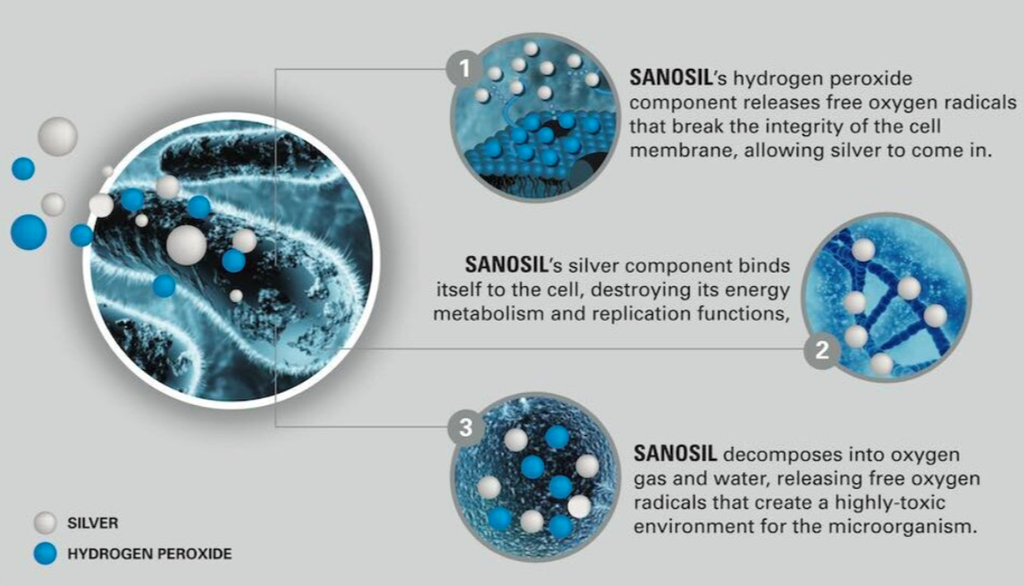
How does SANOSTAT work?
SANOSTAT provides a multi-faceted killing mechanism that provides both contact and residual disinfection.
Does SANOSTAT bleach or discolor surfaces?
NO.
Under normal recommended use, SANOSTAT is not expected to bleach surfaces.
Try it on wood, and see how there’s no reaction, no whitish discoloration.
Try it on a black shirt, again, no discoloration.
Just the same, as a matter of practice,
always perform a patch test on all new surfaces.
Choose a hidden section, apply a little product,
and leave overnight to see if there are any adverse affects.
Is SANOSTAT really made in Switzerland?
YES.
- SANOSTAT works entirely because of the proprietary Swiss technology behind it
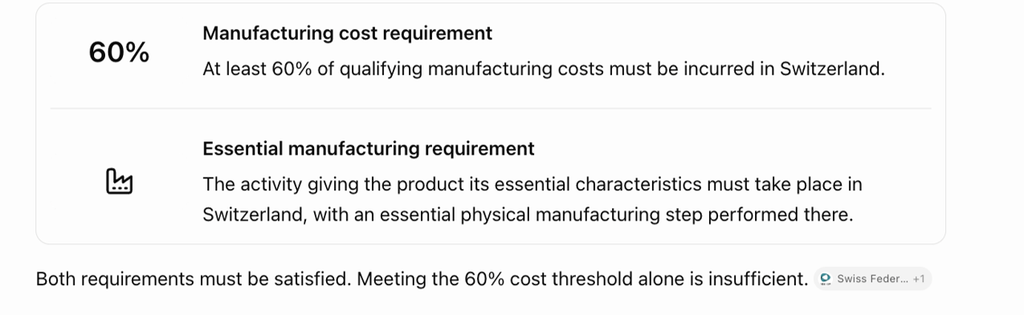
- SANOSTAT’s active ingredient is made in Switzerland and constitutes 60% of the manufacturing cost
- The critical manufacturing process is done in Switzerland
These fulfill the three main legal requirements indicated by
the Swiss Federal Institute of Intellectual Property (IPI), namely:
So, what’s the catch?
We can think of five:
- The temporary sour smell when in contact with germs and organics:
if you can get over this, this is the worst of it. - Price: You get what you pay for, and SANOSTAT is obviously not as cheap as bleach.
We are comparable to your spray can disinfectants.
BUT with SANOSTAT, you are paying for the effective technology, and not the label or brand. - Packaging: SANOSTAT needs a breathing mechanism, to let out the oxygen released by hydrogen peroxide. Otherwise, the bottle inflates and deforms (BTW, this is yet another way to tell it apart from regular hydrogen peroxide)
- Fresh white paint: white paint has an ingredient that reacts with SANOSTAT. It must be fully dried before SANOSTAT is applied to it. Once applied on any surface, always spread evenly while wet.
- Use on “sealed” surfaces: painted low alloy metals, varnished wood, sealed marbles and stones, waxed leathers, etc.
Compatibility is mostly good, if not, just test patch to check.
That’s the entire fine print, to the best of our knowledge and experience.
STILL HAVE QUESTION?
Our team is here to help you learn more about SANOSTAT.